
 Scrape. Grind. Crunch. If your car is making a grinding noise it can be unnerving.
Those are not sounds you want to hear coming from your car.
If your car is making a grinding noise, your first question is probably pretty simple: What is that—and can I keep driving?
The answer depends a lot on when the grinding happens.
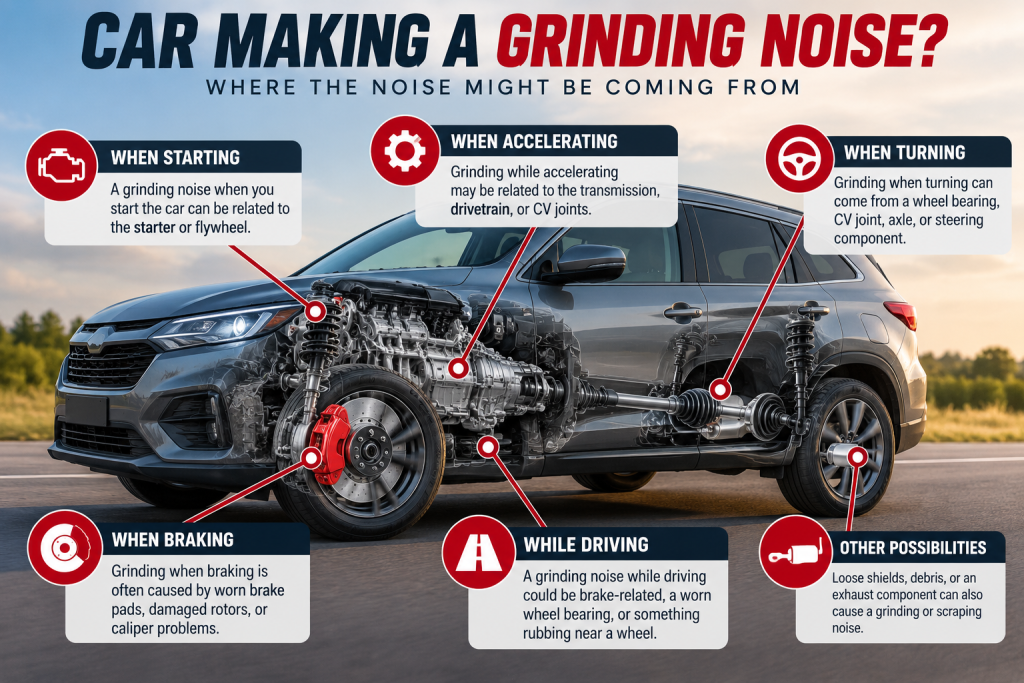
A grinding noise when you step on the brakes points us in a different direction than grinding when you turn, accelerate, or start the engine. Paying attention to exactly when you hear the sound can provide an important clue about what’s happening with your vehicle.
Here’s what your car’s grinding noise could be trying to tell you.
Grinding When You Brake
This is probably one of the most recognizable—and important—grinding noises.
If you hear grinding when braking, worn brake pads may be the culprit. Brake pads have friction material that wears down over time. If they’re allowed to wear far enough, metal components can begin contacting the brake rotor.
And metal-on-metal is exactly what it sounds like.
You might also notice:
- Squealing or scraping
- Vibration when braking
- The vehicle pulling to one side
- Reduced braking performance
- A brake warning light
A sticking brake caliper or damaged rotor can also create grinding or scraping noises.
Bottom line: If your brakes are grinding, don’t wait for the sound to get worse. Have the braking system inspected.
Car Making a Grinding Noise While You’re Driving
What if you hear the grinding even when you aren’t touching the brake pedal?
That’s where things get more interesting.
A car making a grinding noise while driving could still be brake-related, but it may also come from a wheel bearing, something rubbing near a wheel, a bent brake dust shield, or another component.
Pay attention to whether the sound gets faster or louder as your vehicle gains speed.
A worn wheel bearing, for example, may produce a grinding, humming, or growling sound that changes with vehicle speed.
This is also a good time to ask yourself:
Does the noise change when I turn?
That little detail can be extremely helpful when diagnosing the problem.
Grinding When You Turn
If the grinding becomes more noticeable when turning left or right, the problem may be related to a wheel bearing, CV joint, axle, steering component, or suspension component.
CV joints often make clicking or popping noises when they’re failing, particularly during tighter turns. More significant wear can produce other sounds as well.
A wheel bearing can also change pitch or volume as the vehicle’s weight shifts during a turn.
Don’t worry about diagnosing exactly which component it is from the driver’s seat.
Instead, remember this:
If turning the steering wheel consistently changes the noise, tell your technician.
That’s useful information.
Grinding When You Accelerate
A grinding noise when accelerating can have several possible sources.
Depending on the vehicle and exactly where the sound is coming from, drivetrain components, axles, CV joints, transmission components, or other moving parts could be involved.
Pay attention to whether the grinding:
- Only happens from a stop
- Happens at a certain speed
- Changes when you let off the accelerator
- Is accompanied by vibration
- Happens when the transmission shifts
The more specifically you can describe when it happens, the easier it is to narrow down the source.
Grinding When You Start the Car
Here’s one that’s very different from the others.
If you hear a grinding noise when starting your car, particularly for a second or two while the engine is cranking, the starter may not be engaging properly with the flywheel or flexplate.
You might notice that the vehicle occasionally doesn’t start on the first attempt or that the grinding only happens intermittently.
Don’t repeatedly crank the engine hoping it’ll eventually behave. If something isn’t engaging properly, continuing to do it could cause additional damage.
Have it checked.
Can I Keep Driving If My Car Is Making a Grinding Noise?
Maybe—but grinding isn’t a noise we’d recommend ignoring.
Some causes are relatively minor. Others can involve your brakes, wheel bearings, axles, drivetrain, or other components that can affect vehicle safety.
You should be especially cautious if the grinding is accompanied by:
- Poor or unusual braking
- Steering problems
- Strong vibration
- A burning smell
- Warning lights
- Fluid leaking from the vehicle
- Low Power Steering Fluid
- A sudden change in how the vehicle drives
If you’re experiencing any of those symptoms, don’t assume the vehicle is safe to continue driving.
Even without additional symptoms, a new grinding noise deserves attention.
Help Your Mechanic Find the Car is making a Grinding Noise
Here’s something you can do before bringing the vehicle in:
Pay attention to exactly when it makes the noise.
You don’t need to know what’s wrong. That’s our job.
But knowing that “it grinds whenever I turn left at low speeds” is much more useful than “my car makes a weird noise sometimes.”
Try to notice:
- Does it happen while braking?
- Does it happen while turning?
- Does it happen while accelerating?
- Does the sound change with speed?
- Is it coming from the front or rear?
- Does it happen when the vehicle is cold?
- Does it happen every time or only occasionally?
If it’s safe to do so, you can even record the sound on your phone. A recording can sometimes help if the vehicle decides not to make the noise once it’s at the shop. (Cars seem to be pretty good at that.)
Car Making a Grinding Noise in Austin, MN?
You shouldn’t have to turn up the radio and pretend you don’t hear it.
If your car is making a grinding noise, bring it to Gappa Automotive in Austin, Minnesota and let us track down where it’s coming from.
Whether the grinding happens while braking, driving, turning, accelerating, or starting the engine, we’ll help determine what’s causing the noise and what needs to be done about it.
Hear something that doesn’t sound right? Let Gappa Automotive take a listen.
Sources
AAA
https://www.acg.aaa.com/connect/blogs/5c/auto/how-to-know-if-your-brakes-are-going-bad
MOOG
https://www.moogparts.com/parts-matter/what-causes-grinding-noise-under-my-car.html
Firestone Complete Auto Care
https://www.firestonecompleteautocare.com/blog/maintenance/bad-cv-axle-symptoms/
NAPA
https://knowhow.napaonline.com/why-do-good-starters-go-bad/