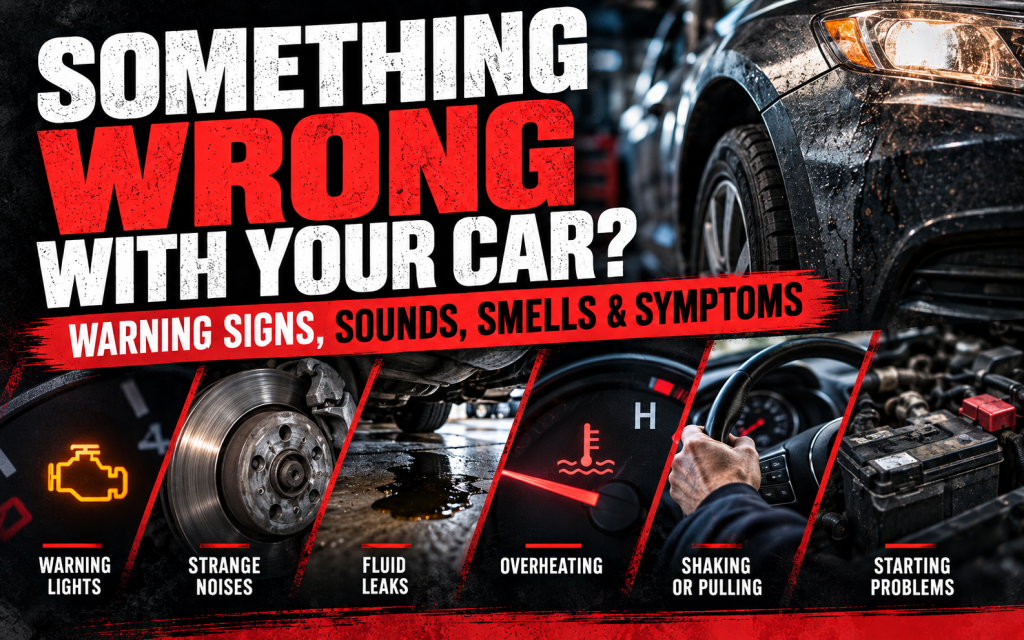
 Cars have a way of telling you when something isn’t right.
Sometimes it’s obvious: a warning light appears on the dashboard or the engine won’t start. Other times, the first clue is subtler—a new vibration in the steering wheel, a faint grinding sound, an unfamiliar smell or a small puddle underneath the vehicle.
The difficult part is figuring out what those symptoms actually mean.
A strange sound doesn’t automatically tell you which part has failed. A check engine light doesn’t identify the repair you need. Even the color of fluid underneath your vehicle may only provide a clue.
That’s why we created this guide.
If something about your vehicle suddenly sounds, smells, feels or looks different, use this page as a starting point. We’ll walk through common car problems, what can cause them, how urgently they should be addressed and where you can learn more.
AAA recommends paying attention to new sounds, fluid leaks and dashboard warning lights rather than assuming they’ll disappear on their own. AAA
Important: This guide can help you recognize symptoms, but it cannot diagnose your vehicle. Many automotive problems produce similar symptoms. Proper inspection and testing are often necessary to determine the actual cause.
Something Wrong With Your Car? Start Here
Not sure where to begin? Start with what you’ve noticed.
| What you’re noticing | Possible systems to investigate |
|---|---|
| Grinding, squealing, clicking or clunking | Brakes, suspension, engine, belts, bearings or drivetrain |
| Burning, sweet, gasoline or sulfur-like smell | Fluids, cooling system, electrical system, fuel system or exhaust |
| Dashboard warning light | Depends on the specific warning and vehicle |
| Shaking or vibration | Tires, wheels, brakes, suspension, engine or drivetrain |
| Vehicle pulling to one side | Tires, alignment, suspension or brakes |
| Fluid underneath the car | Oil, coolant, transmission, brake or other vehicle fluid—or normal AC condensation |
| Hard starting or no-start | Battery, charging, starting, ignition, fuel or other systems |
| Overheating | Cooling-system or engine problem |
| Loss of power | Engine, fuel, ignition, exhaust, transmission or electronic controls |
The key word here is possible.
Automotive symptoms overlap considerably, which is why replacing a part based only on a sound or warning code can turn into an expensive guessing game.
1. Strange Car Noises: What Is Your Vehicle Trying to Tell You?
One of the easiest ways to notice a developing car problem is with your ears.
You drive your vehicle regularly, so you’re familiar with its normal sounds. When a new grinding, squealing, clunking or clicking sound suddenly appears, it’s worth paying attention.
AAA similarly recommends investigating unfamiliar sounds rather than dismissing them as normal aging. AAA
Grinding
Grinding deserves attention because several different systems can produce it.
If it happens while braking, worn brake components are one possibility. If the grinding changes with vehicle speed, wheel bearings or drivetrain components may need to be investigated. Grinding from underneath the hood can point somewhere else entirely.
We’ve put together a deeper guide specifically for this symptom:
Related: Car Making a Grinding Noise? 7 Possible Causes
If the noise happens specifically while stopping, learn more about brake repair and common brake symptoms at Gappa Automotive.
Squealing or squeaking
A high-pitched squeal can come from several places.
During braking, some brake pads use wear indicators designed to produce a high-pitched sound as the pads become thin. AAA notes that a persistent high-pitched brake squeal can be a reason to have the brakes inspected. AAA Club Alliance
A squeal underneath the hood, however, may involve a belt or pulley. A squeal while turning could point toward a steering-related issue on some vehicles.
When the noise occurs matters just as much as what it sounds like.
Clunking
Does your car clunk when you hit a bump?
Suspension components are one possibility. AAA notes that worn or loose suspension components can create a clunk over rough surfaces, although something as different as a loose exhaust component can sometimes produce a similar sound. AAA Club Alliance
That’s a great example of why a sound alone isn’t a diagnosis.
Clicking
A rapid clicking sound when you turn the key or press the start button can be associated with starting or electrical problems.
Clicking while turning or driving can have entirely different causes.
Pay attention to:
- Whether the vehicle is moving
- Whether you’re turning
- Whether the engine is running
- Whether the sound changes with speed
- Where the sound seems to originate
Those details can be extremely useful when explaining the problem to a technician.
Knocking or ticking
An unusual knock or tick from the engine compartment should not simply be written off as an older engine making noise.
There are numerous possible causes ranging from relatively minor to serious. If the noise is new, getting louder or accompanied by a warning light, poor performance or low oil pressure, have it investigated.
Humming or growling
Tires naturally create road noise, but a new humming or growling sound that increases or changes with speed can warrant an inspection.
Possible sources can include tire wear, wheel bearings and drivetrain components.
Bottom line: If your vehicle suddenly develops a sound you’ve never heard before, don’t diagnose it based on the sound alone—but don’t ignore it either.
2. What Do Strange Car Smells Mean?
Your nose can sometimes identify a problem before your dashboard does.
Some odors are harmless. Others deserve immediate attention.
Burning smell
A burning odor has numerous potential sources.
Hot brakes, oil or another fluid reaching a hot surface, a slipping belt, overheated components and electrical problems can all create different kinds of burning smells. AAA identifies overheated brakes, belts, leaking fluids and electrical insulation among possible sources. AAA
If you see smoke or the smell is strong and sudden, find a safe place to stop rather than continuing to drive while hoping it disappears.
Sweet smell
A noticeably sweet or syrup-like odor can indicate coolant.
Coolant leaks can eventually result in overheating if enough coolant is lost. AAA specifically identifies a sweet odor as a possible coolant-leak symptom. AAA Club Alliance
If the temperature gauge is climbing or an overheating warning appears, the situation becomes much more urgent.
Gasoline smell
A persistent gasoline odor should not be ignored.
There are multiple possible causes, including fuel-system problems. Because leaking fuel can create a fire hazard, a strong gasoline smell deserves prompt attention. AAA
Rotten egg or sulfur smell
A sulfur-like smell can be associated with exhaust/emissions problems and other vehicle issues.
Rather than replacing a catalytic converter based on smell alone, have the underlying problem properly diagnosed.
Musty smell from the vents
Musty or moldy odors are a different category.
Moisture, cabin filtration and HVAC issues can contribute to unpleasant odors coming through the vents.
If your HVAC system isn’t cooling properly in addition to smelling strange, Gappa has more information about automotive air-conditioning service and repair. Gappa Automotive
3. Dashboard Warning Lights You Shouldn’t Ignore
Modern vehicles continuously monitor dozens of systems. Warning lights are one way the vehicle tells you something needs attention.
But not every dashboard light means the same thing, and the symbols and procedures can differ between manufacturers.
Your owner’s manual should always be the first reference for the specific warning displayed by your vehicle.
Here are several common warnings worth understanding.
Check engine light
The check engine light can illuminate for many different reasons.
The important distinction is that the light indicates the vehicle’s computer has detected a fault—it does not tell you which part should be replaced.
A diagnostic trouble code gives a technician a starting point for further testing.
A flashing check engine light is more urgent than a steady one. AAA advises drivers to pull over safely and arrange assistance when the check-engine light is flashing because it can indicate a more serious problem. AAA
Oil pressure warning
An oil-pressure warning deserves immediate attention.
Adequate lubrication is critical to an engine. Continuing to operate an engine without proper oil pressure can result in serious damage.
If an oil-pressure warning appears while driving, safely stopping the vehicle and checking the manufacturer’s instructions is preferable to assuming you can make it home.
Engine temperature warning
An overheating engine can quickly turn a repairable cooling-system problem into substantial engine damage.
If your temperature gauge moves unusually high, an overheating warning appears, or you see steam, safely pull over and shut the vehicle down.
And never remove a radiator cap from a hot cooling system.
Battery/charging warning
A battery symbol doesn’t necessarily mean, “Buy a new battery.”
It generally indicates a charging-system issue. The battery, alternator, wiring, connections or another component may need testing.
That’s another example of a warning identifying a system rather than identifying the failed part.
Brake and ABS warnings
Brake-system warnings deserve prompt attention because braking performance directly affects vehicle safety.
If a brake warning is accompanied by a soft pedal, greatly reduced braking ability, pulling or other major changes, don’t continue driving simply because the vehicle still moves.
Tire Pressure Monitoring System (TPMS)
When the TPMS warning illuminates, NHTSA says at least one tire is significantly underinflated and recommends inspecting the tires and checking pressure as soon as possible. NHTSA
Don’t use the number printed on the tire sidewall as your target pressure. Check the vehicle’s tire-information placard—typically located around the driver’s door—or the owner’s manual for the manufacturer’s recommended cold pressure. NHTSA
4. Why Is My Car Shaking or Vibrating?
A vibration can tell you quite a bit about when a problem occurs, but not necessarily exactly what failed.
Ask yourself:
Does it shake while braking?
Brake components are one possibility.
Does the steering wheel shake at highway speeds?
Tire/wheel balance, tire condition, suspension and other rotating components may need investigation.
Does it vibrate during acceleration?
Engine, drivetrain and axle-related issues are among the possibilities.
Does it shake while sitting still?
Now the investigation may move toward the engine and its related systems.
That distinction is useful information for a technician.
Why is my car pulling to one side?
A vehicle that consistently pulls left or right may have an alignment problem, but alignment isn’t the only possibility.
Tire pressure, uneven tire wear, suspension problems and brake problems can also affect how a vehicle tracks.
Gappa’s guide to wheel alignment and tire rotation goes deeper into pulling, uneven tire wear, steering-wheel vibration and alignment problems. Gappa Automotive
What if the steering suddenly becomes difficult?
A steering wheel that suddenly becomes unusually heavy is a different problem.
Depending on the vehicle, hydraulic or electric power-steering components could be involved.
Gappa’s guide to power-steering failure covers stiff steering, steering-related noises, hydraulic-fluid leaks and warning indicators in greater detail. Gappa Automotive
A major or sudden change in steering should be treated as a safety concern.
5. What’s Leaking Under My Car?
Few things get a driver’s attention faster than discovering a puddle where the car was parked.
The good news is that not every puddle is a vehicle failure.
Water underneath a vehicle after running the air conditioner is often simply condensation. AAA specifically identifies plain water from the AC as a normal exception to the general rule that vehicle fluid leaks need attention. AAA Club Alliance
Other fluids warrant investigation.
Dark brown or black fluid
This could be engine oil, particularly if it feels oily and appears underneath the engine area.
Red or reddish-brown fluid
Transmission fluid is one possibility.
Some hydraulic power-steering systems also use reddish fluid, so location and vehicle design matter.
Green, orange, pink or blue fluid
These colors are commonly associated with different coolant formulations.
A coolant leak is especially important if accompanied by a sweet smell or increasing engine temperature.
Clear to light-yellow oily fluid
Brake fluid can appear relatively clear to yellowish when new and darken with age.
Because the braking system is safety-critical, a suspected brake-fluid leak deserves immediate attention.
AAA provides similar general characteristics for oil, transmission fluid, coolant, brake fluid and power-steering fluid. AAA
Clear water
If it’s odorless water and you’ve recently been using the air conditioner, condensation is a likely explanation.
Don’t diagnose a leak by color alone
Vehicle fluids change appearance as they age. Dirt, rust and other contaminants can alter their color. Different manufacturers also use different formulations.
Think of fluid color as a clue, not proof.
6. Why Won’t My Car Start?
You turn the key or push the button and…
Nothing.
Unfortunately, “car won’t start” isn’t a diagnosis either.
The way it fails to start provides useful clues.
Nothing happens
Battery charge, battery connections, electrical systems, starter controls and other components may need investigation.
Rapid clicking
A weak battery or poor electrical connection is among the common possibilities.
Engine cranks slowly
Again, battery condition and electrical resistance are possibilities, but proper testing is preferable to automatically replacing the battery.
Engine cranks normally but won’t start
Now the possibilities become much broader.
Fuel delivery, ignition, sensors, mechanical problems, security systems and electronic controls are among the systems that can prevent an engine from starting.
Starts and then dies
That’s another distinct symptom with numerous possible causes.
The takeaway is simple:
“It won’t start” tells us what the car is doing. Testing tells us why.
7. Rough Idle, Stalling and Loss of Power
Some vehicle problems aren’t announced by a warning light or dramatic noise. The car simply stops behaving normally.
Rough idle
A rough-running engine can have ignition, fuel, air-intake, sensor, mechanical or other causes.
Stalling
An engine that shuts off unexpectedly should be investigated promptly, particularly because losing power while driving can create a dangerous situation.
Poor acceleration or loss of power
If your vehicle suddenly struggles to accelerate, don’t assume it’s automatically a transmission problem—or automatically an engine problem.
Modern engines and transmissions are controlled by interconnected electronic systems, and numerous faults can result in reduced performance.
Sudden drop in fuel economy
Driving habits and weather affect fuel economy, but an unexplained decline can also be a warning sign. AAA lists a sudden decline in fuel economy among symptoms worth investigating. AAA Club Alliance
Overheating
Overheating deserves special attention because continued operation at excessive temperatures can cause significant engine damage.
If the temperature climbs into the danger zone or you receive an overheating warning, safely pull over rather than trying to squeeze out another few miles.
8. Minnesota Creates Its Own Car Problems
Vehicles in southern Minnesota live a harder life than vehicles in many parts of the country.
We deal with bitter cold, summer heat, road salt, snow, ice and potholes—sometimes within a surprisingly short period of time.
Gappa’s complete car-maintenance schedule goes into much greater detail about maintaining a vehicle under Minnesota driving conditions. Gappa Automotive
But several Minnesota-specific problems deserve special mention here.
Cold weather and batteries
Cold weather makes starting an engine more demanding while battery performance can be reduced by low temperatures.
A battery that seemed fine during warmer weather can suddenly reveal its weakness on a bitter Minnesota morning.
Tire pressure changes
Cold weather can expose marginal tire inflation.
NHTSA notes that a TPMS warning may appear on a cold morning when tire pressure falls below the system’s threshold, then disappear as the tires and outside temperature warm. That doesn’t mean the warning should simply be ignored—the tires should still be checked and adjusted to the vehicle manufacturer’s specified cold pressure. NHTSA
Potholes
Spring can be brutal on Minnesota roads.
A significant pothole impact can damage a tire or wheel and may contribute to alignment or suspension problems. NHTSA specifically notes that a tire can suddenly lose pressure after hitting a pothole or curb. NHTSA
If your vehicle starts pulling, vibrating or handling differently immediately after a hard pothole strike, have it inspected.
Road salt and corrosion
Road salt helps keep Minnesota roads passable, but it’s hard on vehicles.
The underbody, brake components, fasteners and other exposed metal components all live in that environment throughout winter.
No heat or defrost
In Minnesota, a heater problem isn’t merely inconvenient.
Defrosting and defogging are important for visibility, which makes HVAC performance a safety consideration during winter.
Summer heat and air conditioning
Then Minnesota changes direction.
When summer temperatures arrive, an AC system that was marginal in spring can suddenly become very noticeable.
If the air coming from your vents isn’t getting cold, visit Gappa’s Air Conditioning Service & Repair guide for more information. Gappa Automotive
9. When Should You Stop Driving?
Not every car problem requires a tow truck.
But some symptoms shouldn’t be tested with a “let’s see if I can make it home” approach.
AAA advises pulling over for serious warning signs such as smoke, major operational changes and certain flashing dashboard warnings. AAA
Stop somewhere safe and get help if you experience:
- A serious loss of braking ability
- Sudden major difficulty steering or controlling the vehicle
- Engine overheating or significant steam
- An oil-pressure warning that remains illuminated
- A flashing check engine light
- Smoke or signs of fire
- A strong fuel smell that could indicate a leak
- Sudden severe shaking or a suspected tire failure
- A loud mechanical failure followed by a major change in how the vehicle drives
This isn’t an exhaustive list. Conditions vary by vehicle and situation.
If you aren’t confident the vehicle can be operated safely, don’t gamble with it.
10. A Symptom Is a Clue—Not a Diagnosis
If there’s one idea to remember from this entire guide, make it this:
The symptom tells you where to start looking. It doesn’t necessarily tell you what to replace.
Consider these examples:
A grinding noise might involve brakes—but not every grinding noise is a brake problem.
A vibrating steering wheel could involve tires or wheels—but vibration has numerous potential sources.
A check engine code identifies a detected condition or circuit; it doesn’t necessarily prove that the component named in the code needs replacing.
A red puddle provides information about the possible fluid, but it doesn’t identify exactly where the leak originated.
And a car that won’t start doesn’t automatically need a battery.
This is why good automotive diagnosis combines what the driver has noticed with visual inspection, vehicle data and appropriate testing.
Diagnose first. Repair second.
That’s usually a much better strategy than replacing parts until the symptom disappears.
11. The Best Car Problem Is the One You Prevent
You can’t prevent every mechanical failure.
Parts eventually wear out, unexpected failures happen and Minnesota roads aren’t always kind.
But routine maintenance gives you an opportunity to find wear and developing problems before they become roadside emergencies. AAA recommends paying attention to tire condition, tire pressure and vehicle fluids in addition to following regular maintenance. AAA Newsroom
Rather than repeating an entire maintenance schedule here, we’ve already built one:
Car Maintenance Schedule: What to Service at Every Mileage
It walks through maintenance from basic oil-change intervals through higher-mileage service and includes considerations specifically for Minnesota drivers. Gappa Automotive
You can also read our Ultimate Guide to Auto Repair in Austin, MN for a broader look at repairs, maintenance, seasonal vehicle care and choosing a repair shop in the Austin area. Gappa Automotive
Frequently Asked Questions About Car Problems
What are the most common signs something is wrong with a car?
Dashboard warning lights, unfamiliar sounds, unusual smells, leaks, vibration, changes in steering or braking, starting trouble and changes in engine performance can all signal a problem. AAA recommends investigating new warning signs rather than assuming they’ll go away. AAA
Should I drive if my car starts making a strange noise?
It depends on the noise and any accompanying symptoms. A faint new rattle and a loud grinding noise accompanied by poor braking obviously don’t carry the same urgency. If braking, steering, engine temperature or vehicle control is affected—or the noise is severe—stop somewhere safe and seek assistance.
What does a grinding noise mean?
There isn’t one universal cause. Brakes are a common possibility when grinding occurs during braking, but bearings, drivetrain components and other mechanical parts can also create grinding sounds. When the noise happens and where it comes from are important diagnostic clues.
Why is my car shaking?
Tire and wheel problems, brakes, suspension components, engine problems and drivetrain issues can all create vibration. Note whether it happens while braking, accelerating, idling or at a particular speed.
Why is there liquid underneath my car?
It could be engine oil, coolant, transmission fluid, brake fluid or another automotive fluid. It could also simply be water condensation from the AC. Fluid appearance and location provide clues, but the leak should be properly identified. AAA
Can cold weather turn on my tire-pressure light?
Yes. NHTSA says marginally low tire pressure can fall below the TPMS warning threshold on a cold morning and rise again as the tire warms. Check the tires with a pressure gauge and adjust them according to the vehicle manufacturer’s cold-pressure specification. NHTSA
Does a check engine code tell me which part is bad?
Not necessarily. A diagnostic trouble code identifies a condition detected by the vehicle’s onboard diagnostics. Technicians use that information along with additional testing to determine the underlying cause.
When should I stop driving my car?
Major changes in braking or steering, overheating, smoke, a flashing check-engine light, suspected tire failure and other severe symptoms can make continued driving unsafe or risk additional damage. When you’re uncertain about the vehicle’s safety, pulling over somewhere safe and arranging assistance is the prudent choice. AAA
Car Problems? Gappa Automotive Can Help
You don’t need to know exactly what’s wrong with your vehicle before bringing it to a repair shop.
In fact, sometimes the most useful thing you can tell a technician is simply:
“It started making this noise.”
“It shakes when I brake.”
“This light came on yesterday.”
“I smell something after I’ve been driving.”
“It started right after I hit a pothole.”
Those symptoms provide a starting point. From there, proper inspection and diagnostic testing can help determine what’s actually happening.
Gappa Automotive serves drivers in Austin, Minnesota and the surrounding area with vehicle maintenance, diagnostics and repair.
If your car has started telling you something isn’t right, don’t ignore it.
Listen to what it’s telling you—and find out why.
Sources
These are the external references I’d actually publish at the bottom of the article: